

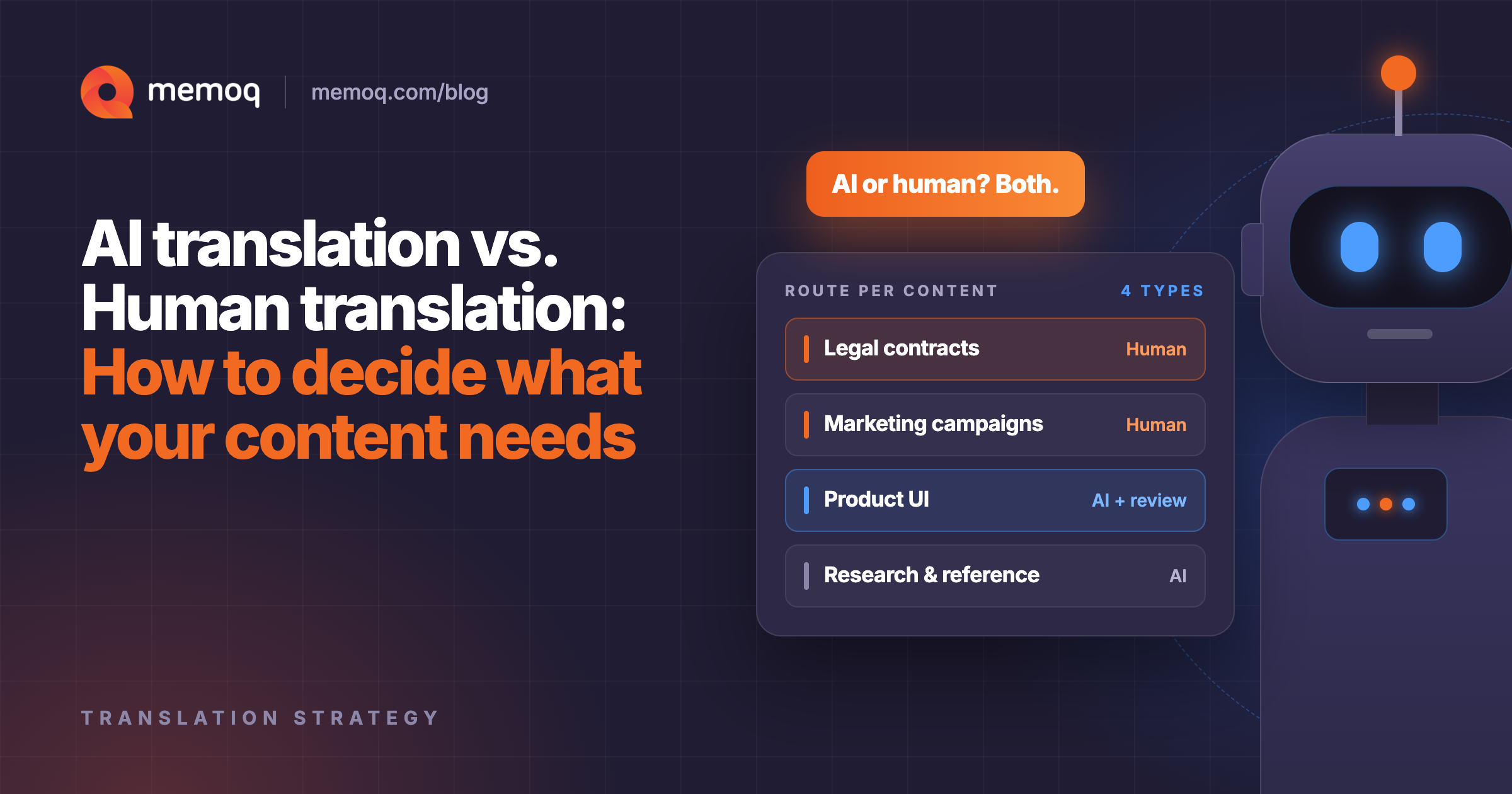
AI translation tools have gotten good fast, leaving many enterprise buyers asking the wrong question: AI translation or human translation? In practice, it’s not an either-or decision because most content needs a mix of both. The real challenge, whether you’re building a translation strategy or defending one, is knowing when to use each.
AI translation uses large language models (LLMs) to translate large volumes of text quickly. Human translation relies on professional linguists for accuracy, brand voice, and cultural nuance. The right choice depends on the content: AI translation works well for high-volume, lower-risk material, and human translation is still necessary for regulated, brand-critical, or high-stakes content.
-
What is the difference between translation, machine translation, and AI translation?
-
What are AI translation and machine translation really good at?
-
What should enterprises consider when choosing an AI translation tool?
What is the difference between translation, machine translation, and AI translation?
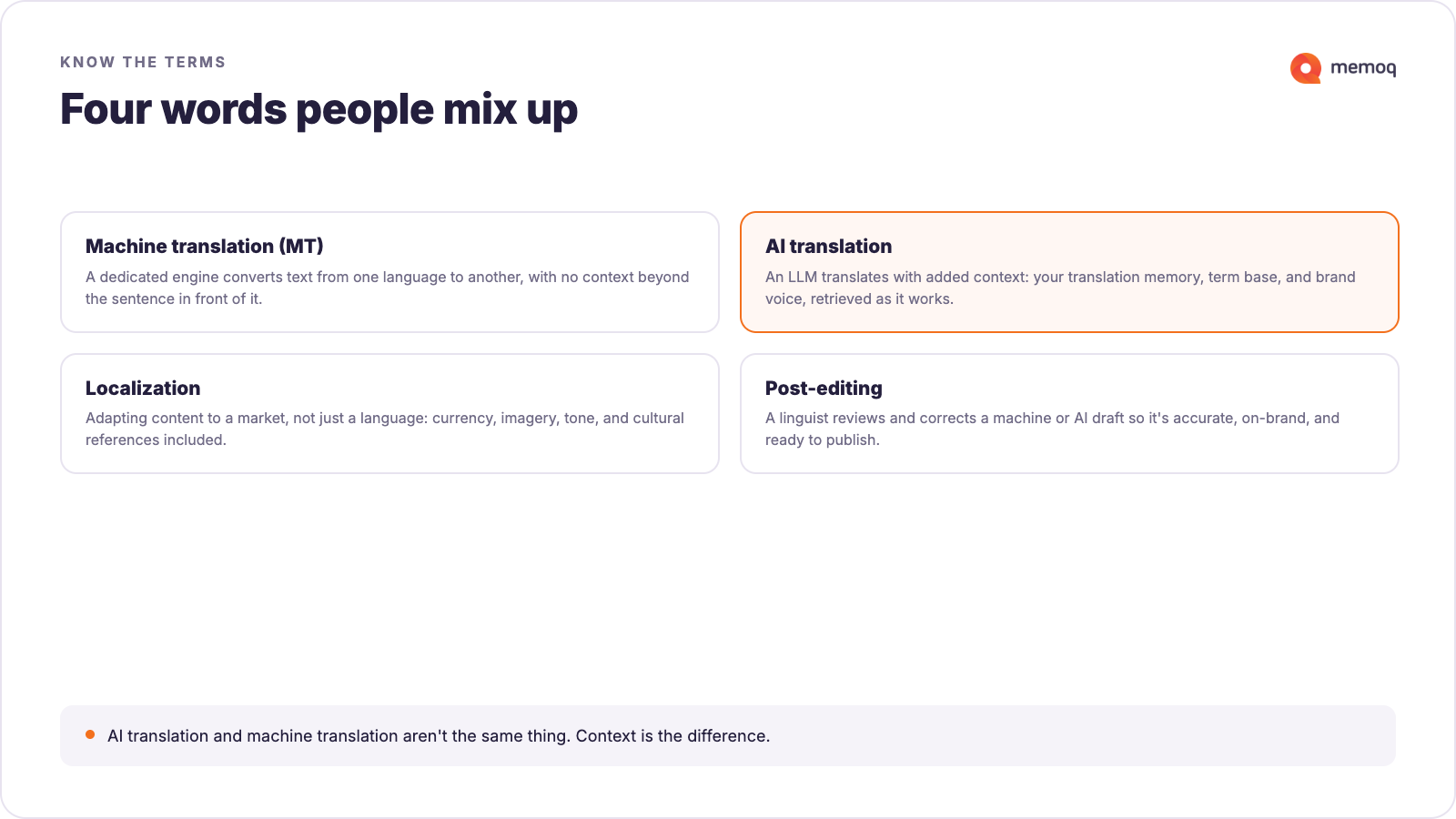
Translation is the act of converting text from one language into another, regardless of whether a person or machine does it.
Localization is the process of adapting currency formats, dates, imagery, legal requirements, and cultural references for a specific market, not just translating the words themselves. This is often where human judgment adds the most value. A sentence can be perfectly translated and still feel wrong to a local reader if those details don’t match local expectations.
Machine translation (MT) is the older, sentence-by-sentence approach to translation. The standard form of machine translation, called Neural Machine Translation (NMT), is fast and inexpensive, but it tends to lose tone or brand voice across a longer document.
AI translation works differently. It uses LLMs to read entire paragraphs or documents at once, instead of sentence by sentence. Because the LLM reads more of the text before translating, the output tends to sound more natural and follows a company's existing terminology and prior translations more closely.
Post-editing is the human review step that follows MT or AI translation, where a linguist checks and adjusts the translation before it's published. That review usually refers to a company's translation memory, a database of text the company has already translated. When similar wording comes up again, it gets reused instead of retranslated from scratch, which keeps terminology consistent from one project to the next.
Understanding these terms helps turn the “AI or human” question into a simpler one: which content needs a human editing pass, and which doesn't.
What are AI translation and machine translation really good at?
AI translation and MT are both fast and cost less than hiring a person to translate. That combination makes them a good fit for high-volume, lower-risk content, such as support articles, product listings, and internal documentation.
Typically, AI and MT are used when understanding matters more than getting every sentence perfect. This content needs to reach customers or employees in their own language but doesn’t require the same polish as a marketing campaign or a legal contract.
Where is human translation still essential?
AI translation has limits. It can mistranslate specialized terminology, and it doesn't always catch the humor or idiom that doesn’t translate directly.
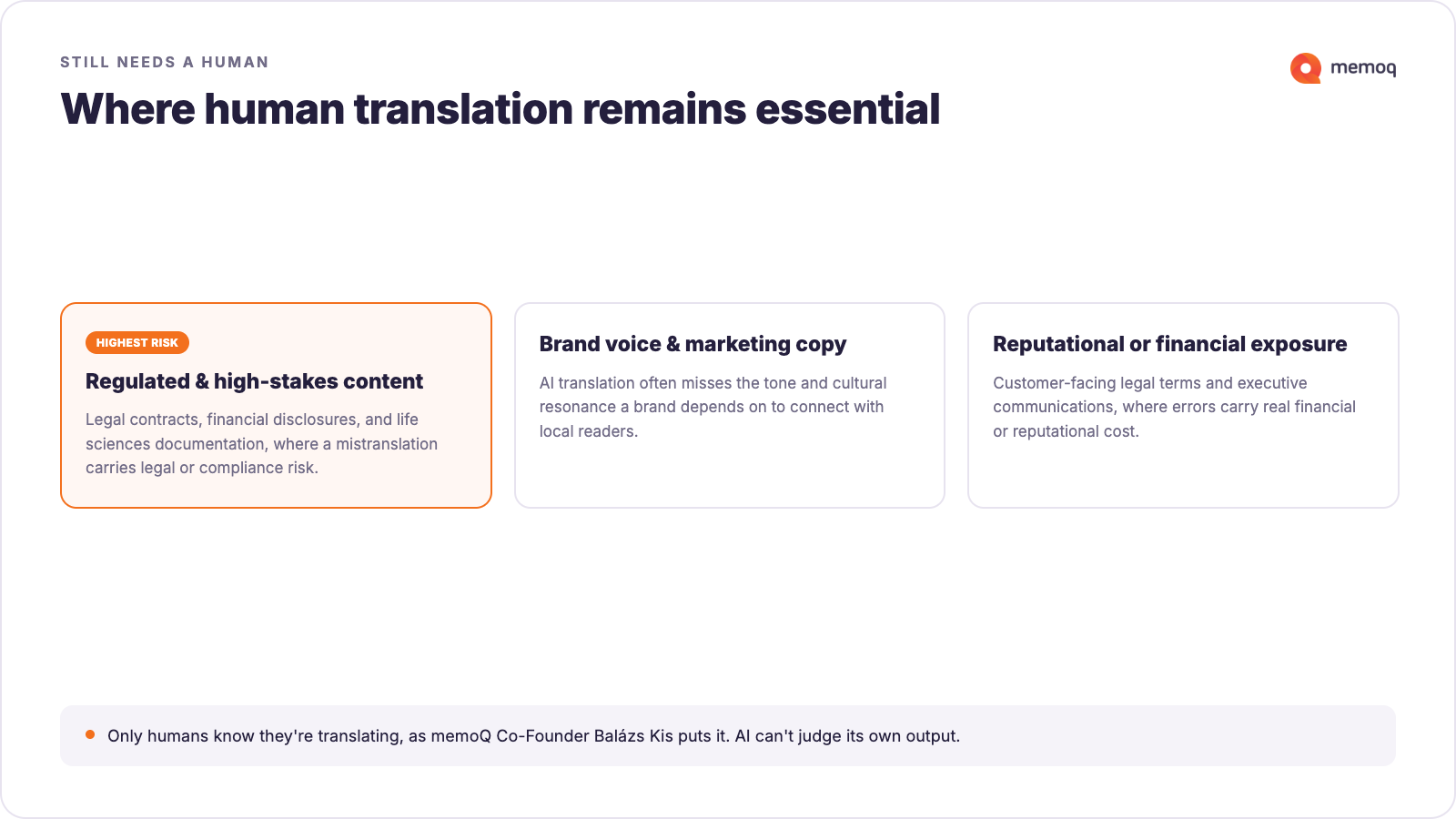
Three categories of content tend to need a human linguist, regardless of how good the underlying technology gets:
- Regulated or high-stakes content, such as legal contracts, financial disclosures, and life sciences documentation, where a mistranslation carries legal or compliance risk.
- Brand voice and marketing copy, where AI translation often misses the tone and cultural resonance a brand depends on.
- Content where a mistranslation carries reputational or financial exposure, such as customer-facing legal terms or executive communications.
For this kind of content, AI translation processes language at scale, but it isn’t evaluating if the translation is right. As memoQ's Co-Founder, Balázs Kis says, only humans know they're translating. His point is that AI has no way to judge its own output, which is why humans must remain at the center of translation workflows.
How do AI translation and human translation compare?
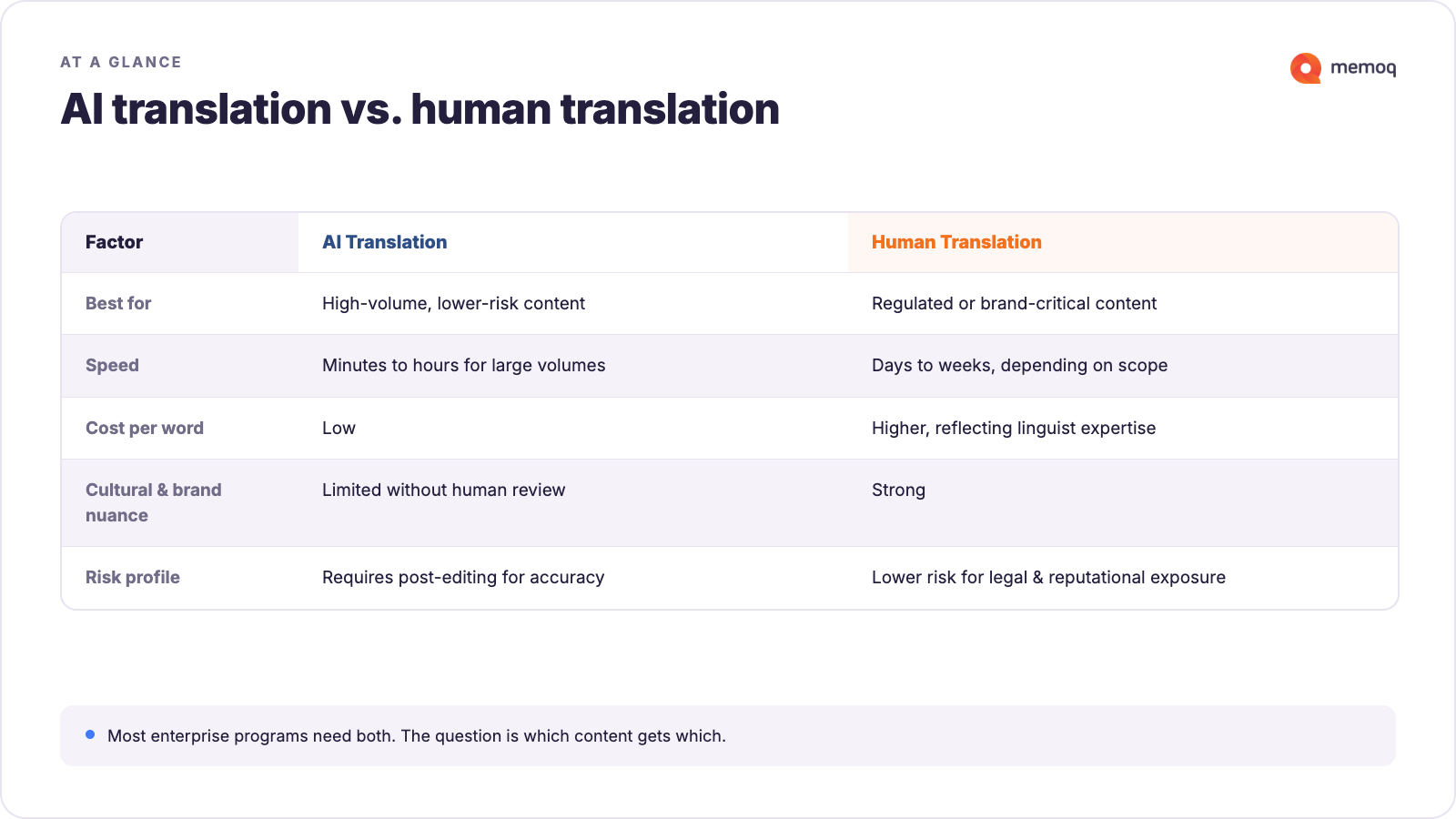
Here's how AI and human translation compare across the factors that typically shape a strategy decision.
How does a hybrid model work?
AI translation and human translation aren’t competitors; they’re two stages of the same workflow. AI translates everything first because it’s fast and affordable. From there, how much a linguist reviews depends on the content: a support article might just need a quick terminology check, while a marketing page or legal contract requires a full review.
The harder part is closing the gap between AI speed and human quality without juggling separate systems for AI translation, translation memory, and review. memoQ AGT (Adaptive Generative Translation) solves that by running all three as one connected process. It pairs an LLM with a company's translation memories and term bases, so translations use approved terminology and match the brand’s voice. Custom model training is not needed. Instead, memoQ AGT retrieves context from the linguistic assets and shares it with the LLM as part of the translation prompt, an approach known as retrieval-augmented generation (RAG). (Here’s a closer look at how this works or see the full AGT guide for more detail.)
memoQ AGT runs inside memoQ's translation management system, so teams manage one platform, and it skips the setup time older MT engines needed. When AI powered translation is run this way, it becomes one step in a workflow instead of a separate task.
A real-world example of a hybrid model
Fondation suisse de déminage (FSD), a Swiss humanitarian organization specializing in mine action, needed to translate large volumes of documentation full of technical terminology. Translation quality was a priority since a single mistranslated term could jeopardize the safety of deminers or local communities.
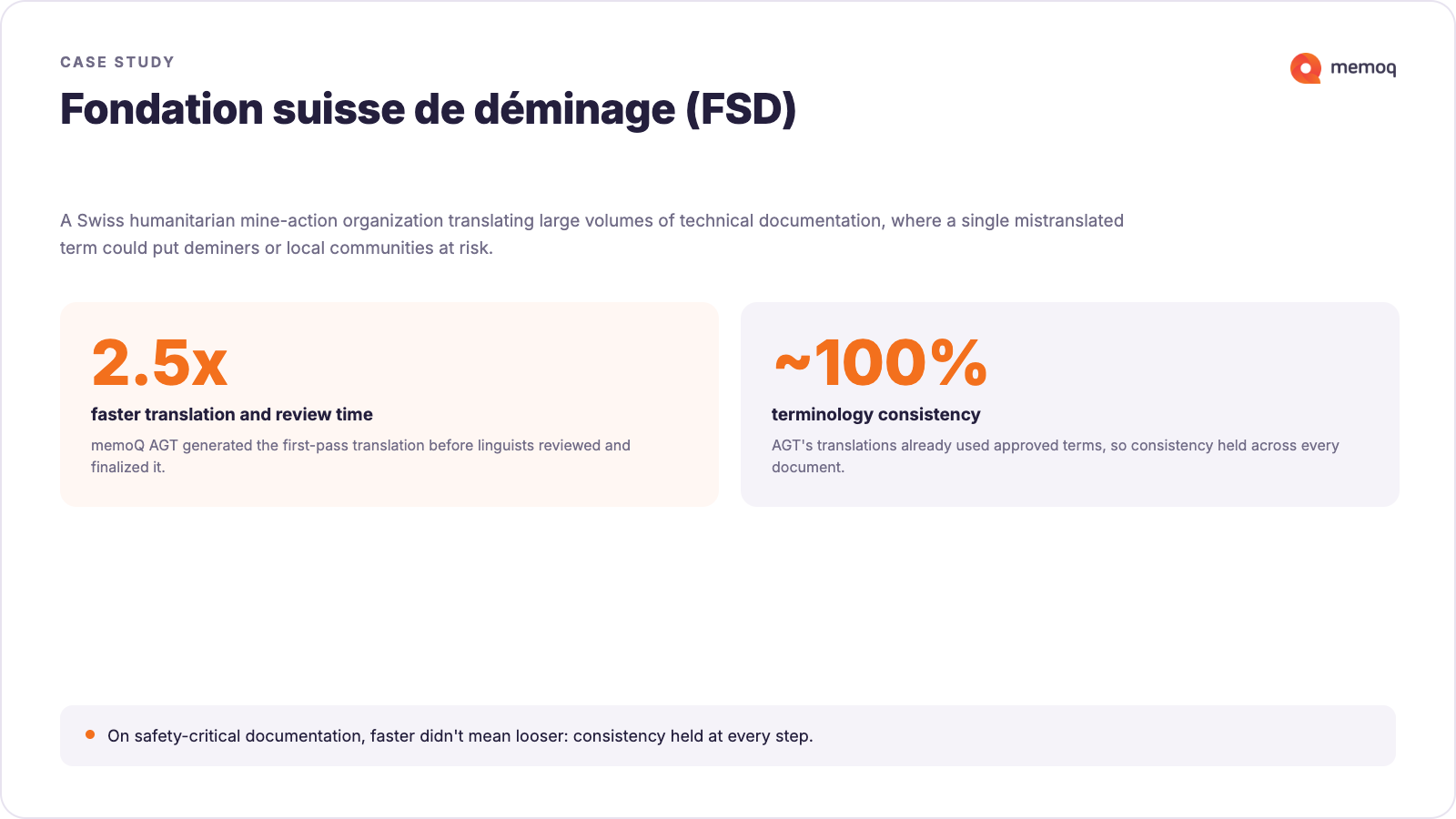
FSD’s team used memoQ and its AGT technology to generate a first-pass translation, then linguists reviewed and finalized it using post-editing. Because AGT’s translations already contained the right terminology, total translation and review time fell by roughly 2.5 times, and terminology consistency remained close to 100%.
What should enterprises consider when choosing an AI translation tool?
Once AI powered translation is part of your translation strategy, the tool itself matters. Data security and quality control at scale are worth investigating before choosing one.
Data security. memoQ AGT runs on Microsoft Azure OpenAI, a limited-access enterprise service that’s separate from consumer tools like ChatGPT. Your data isn’t shared with other customers or with OpenAI, and it isn’t used to train AI models. memoQ TMS is also available as a public cloud, private cloud, or fully on-premises deployment, so IT and compliance teams can choose the level of control they need. memoQ’s ISO 27001 certification and SOC 2 Type 2 compliance are independently audited standards that matter to regulated industries like finance, life sciences, and legal.
Quality control at scale. A good AI translation tool should adapt to your own translation memories and term bases, so output already reflects approved terminology and brand voice, rather than a generic model’s guesses. As translation volume grows, even small inconsistencies can affect translation quality when they multiply across hundreds of documents. Running AI translation, translation memory, and review inside a centralized TMS gives a linguist a single place to catch those inconsistencies before anything gets published.
Choosing the right mix
Enterprise translation programs increasingly run on a combination of AI translation and human translation, with humans still at the center of the workflow. A platform that supports both removes the need to choose one over the other.
Start a free memoQ AGT trial and translate up to 1,000,000 characters to see how AI translation and human translation work together with memoQ. Or book a demo to talk it through with the team first.
Frequently asked questions