


Every day, banks produce and update content that customers, employees, regulators, and business partners need to understand in their preferred languages. This includes product pages, mortgage documents, compliance policies, customer correspondence, mobile banking content, and financial disclosures. Much of it is confidential.
As content volumes grow and turnaround times shrink, translation teams are under pressure to do more with less. When approved translation workflows cannot keep pace with demand, employees may turn to public AI tools to get the job done faster. This creates a governance challenge: sensitive content can end up in tools that have not been assessed or approved by the institution. And once a document is pasted into a public AI tool, no one can say where it went, who stored it, or whether it helped train a model.
The question is not simply whether AI can translate banking content. It is whether your institution can use it at scale while maintaining control over its data, language quality, and customer experience.
What should banks ask before choosing AI translation?
Using AI to speed up your translation can be a good start, but it is not a solution on its own. To assess risks and keep your data protected, use these five questions to evaluate different solutions:
-
Where is our data processed, and who is the provider answerable to?
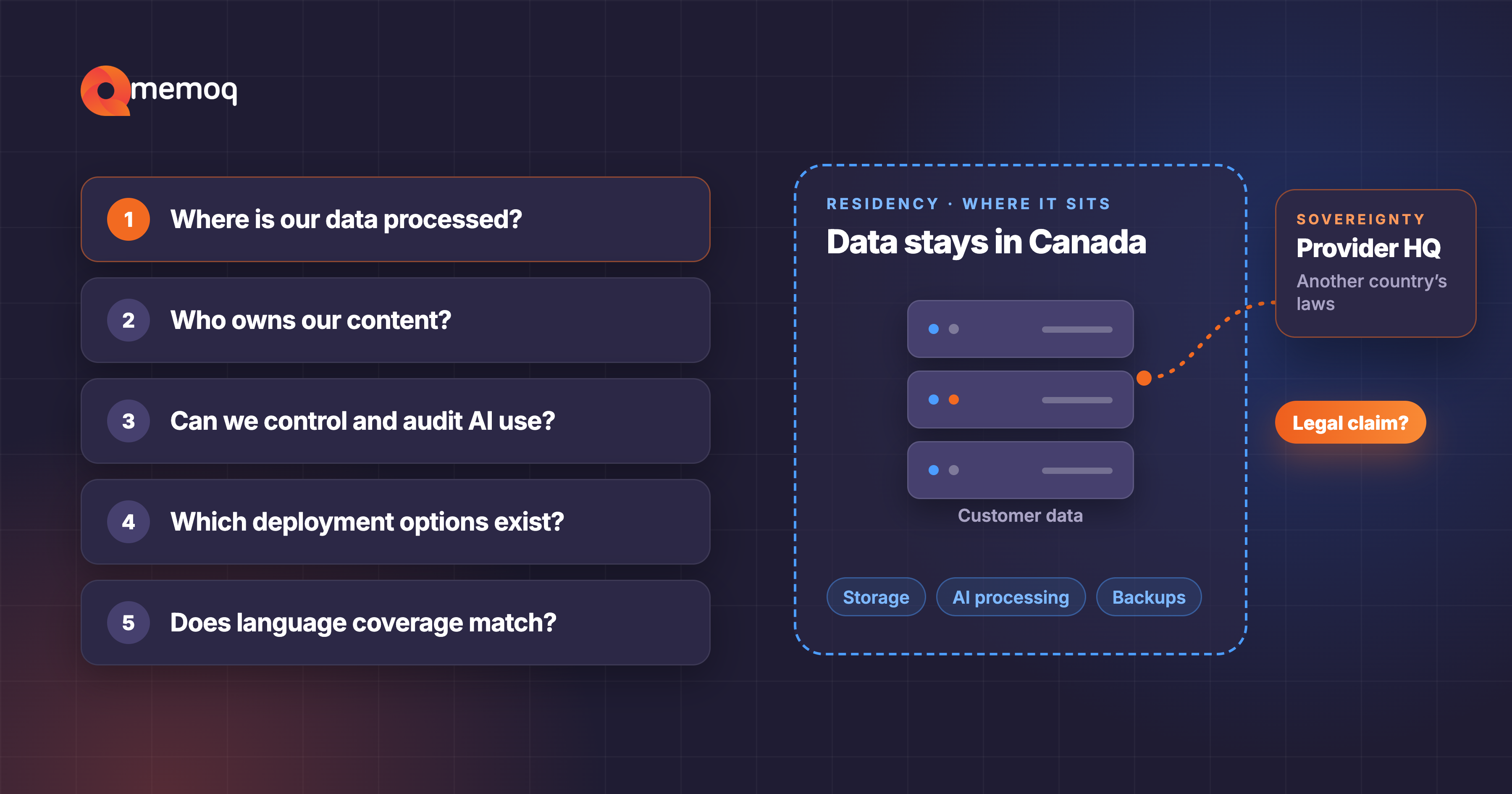
Storage location is only part of the picture. Ask where text is processed by AI engines, where backups sit, and who can access it for support. Then ask which jurisdictions the provider and its subcontractors operate under, because that determines whose rules follow your data. It is also important to distinguish between data residency and data sovereignty. Residency concerns where data is located or processed. Sovereignty concerns the legal authority and jurisdiction that may apply to the data, the service provider, or its operations. For example, a Canadian bank may require its data to stay in Canada. If the provider or its subcontractors operate under another country’s laws, that country’s authorities may still have a legal claim to the data, so ask for answers on both and get them in writing.
-
Who owns our content, and is it used to train any model?
Look for a clear contractual commitment, not a line in a brochure. Also ask about your translation memories and terminology. Your linguistic assets deserve the same attention. Translation memories and terminology databases hold years of approved institutional language. Confirm that they remain yours, that they are not used to train vendor models, and that you can export them in standard formats, such as TMX for translation memories, so you can take them with you if you ever switch vendors.
-
Can we control and audit how AI is used?
A bank should be able to decide when AI is applied, for example by project, language pair, or document type. It should also easily let you see who translated what and with which engine. For localization teams, this means being able to enforce approved terminology, spot inconsistencies between translations, and keep a record of who approved what. For high-stakes content like contracts and disclosures, a human reviewer should stay in the loop because AI output can read fluently and still change the meaning of a legal or financial term. Not sure when to use AI and when to rely on human translators? Read our guide on AI translation vs. human translation.
-
Which deployment options does the vendor offer?
Cloud, private cloud, and on-premises carry different risk profiles, and your requirements may differ by business line. Also, ask how the vendor handles third-party risk, including subcontractor transparency, incident notification, and exit terms.
-
Does language coverage match our customers?
Banks not only serve people in the most widely used languages (such as French and English), but also in newcomer and Indigenous languages in different locations. If a tool doesn’t support them, staff will turn to ones that do, and those are rarely approved.
What does this look like in practice?
A governed translation management system (TMS) gives you one controlled place for translation work, instead of a scattering of unapproved tools. memoQ TMS can be deployed in the cloud or on-premises, with roles, permissions, and workflows that keep humans involved where it matters.
memoQ AGT doesn’t replace translators; it adds AI on top of human-centered processes. It adapts output using your own translation memories and term bases, so models don’t need to be retrained on your content. It runs within Microsoft Azure, and according to an agreement between memoQ and Microsoft, data processed through AGT is not used to train models. memoQ also supports Indigenous languages, which matters for institutions serving diverse communities, especially in North America.
Final thoughts
AI translation is becoming a normal part of banking operations. The question is no longer whether it will be used, but whether it will be used in a way you can see, govern, and defend. Asking where your multilingual data goes, and whose rules follow it, is a good place to start.
Want to see how banks and financial institutions keep multilingual content governed and secure with memoQ? Explore how memoQ TMS and memoQ AGT help banks keep AI translation governed, secure, and human-centered, from where your data is processed to who reviews the final text.
Frequently asked questions
Data residency is where data is located or processed. Data sovereignty is the legal authority and jurisdiction that may apply to the data, the service provider, or its operations.
Not for confidential content. Once a document is pasted into a public AI tool, no one can say where it went, who stored it, or whether it helped train a model. A governed translation workflow keeps that content under your control.
Yes. Choose a solution that lets you decide when AI is applied, shows who translated what and with which engine, and keeps a human reviewer in the loop for high-stakes content such as contracts and disclosures.
No. According to an agreement between memoQ and Microsoft, data processed through memoQ AGT on Microsoft Azure is not used to train models. AGT also adapts output using your own translation memories and term bases, so models don’t need to be retrained on your content.
Yes. memoQ TMS can be deployed in the cloud or on-premises, with roles, permissions, and workflows that keep humans involved where it matters.

Zsófia Lelner
Linguist turned content marketer, telling the story of memoQ.


