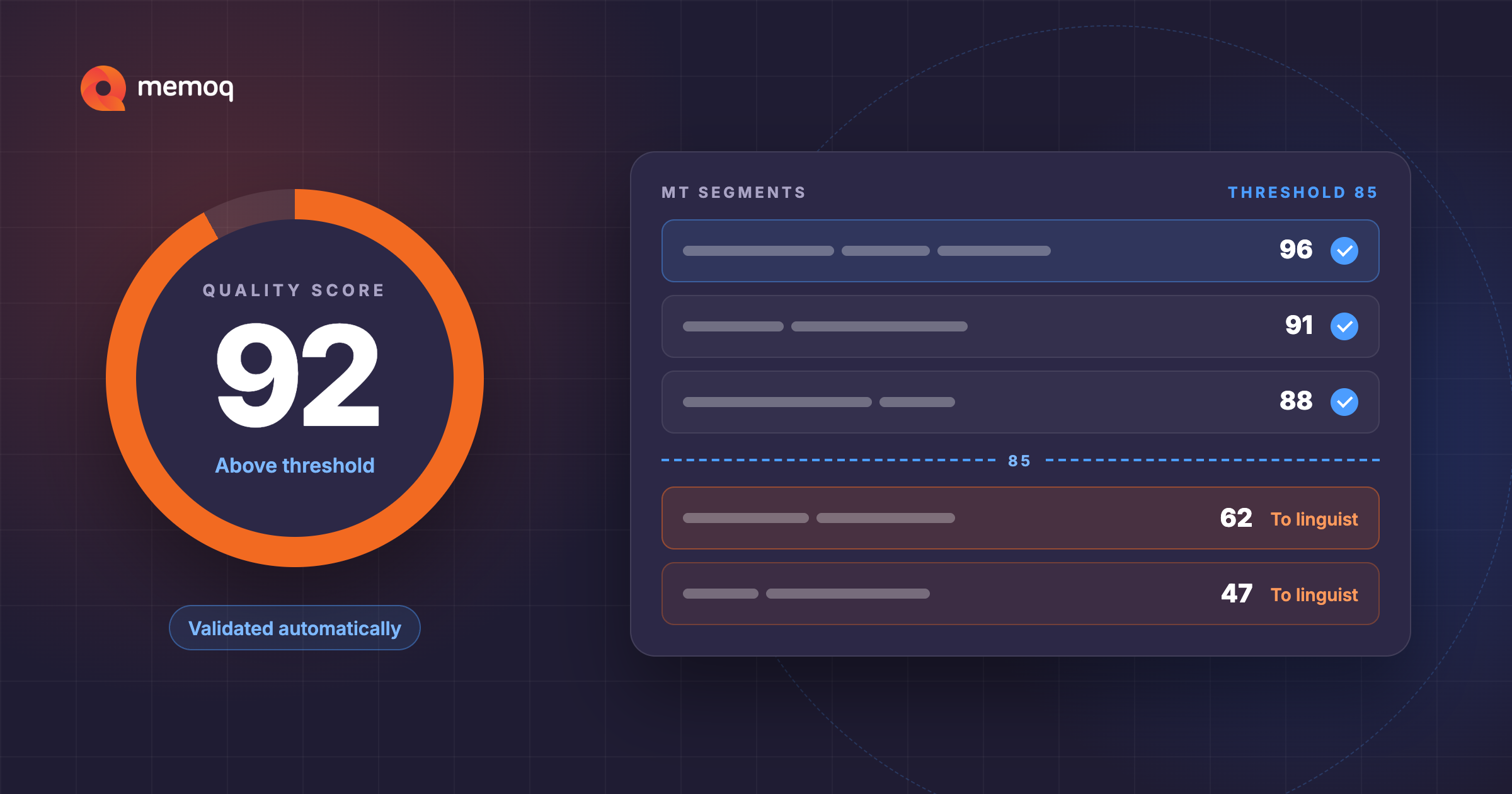
AIQE (AI-based quality estimation) is a quality scoring feature in memoQ TMS that predicts how good each machine-translated segment is before a linguist ever sees it. You set the quality score level you trust. Segments that reach it are validated automatically, and everything else goes to linguists for post-editing. Your team spends human effort only where it truly matters, and your quality standards are maintained.
The scores come from memoQ's long-term technology partners TAUS, Custom.MT and ModelFront, so you get specialist expertise built right into your translation management system (TMS).
In this article
What is machine translation quality estimation?
Machine translation quality estimation is an AI technique that predicts the quality of machine-translated content without needing a human reference translation for comparison. It answers one practical question: can this output be used as it is, or does a person need to fix it?
Here are the key terms in plain language:
-
Machine translation (MT): Text translated automatically by software. MT engines can be generic or custom-trained and include neural machine translation (NMT) systems and large language models (LLMs).
-
Segment: A unit of text, usually one sentence, that a translation tool handles at a time.
-
Post-editing: The work a linguist does to review and correct machine-translated text.
-
Quality score: A number that predicts how close a machine-translated segment is to publishable quality.
Without quality estimation, most teams send every MT segment to a linguist, including the ones that are already meet their quality standards. AIQE removes that guesswork, and it is one of several AI translation tools in memoQ.
Who is AIQE for?
AIQE is built for enterprises and language service providers (LSPs) that already use machine translation and want a better return on it. If MT is part of your workflow, AIQE helps you get more out of every engine you run.
-
Localization teams at enterprises: Teams translating large volumes of product, support or marketing content can reserve linguists' time for high-risk or high-visibility text.
-
LSPs: Language service providers can plan post-editing effort more accurately and protect their margins on MT-heavy projects.
-
Project managers: PMs are the main users. They set thresholds, compare MT engines, and use quality statistics to plan projects.
-
Linguists: Translators and post-editors see quality scores while they work, so they know where to focus and which MT suggestion to start from.
What are the benefits of AIQE?
AIQE cuts post-editing effort while keeping translation quality high, because people only review the segments that need reviewing. Here is what that means day to day:
-
Less post-editing: Segments that meet your threshold are validated automatically, so linguists skip work that adds no value.
-
Clear guidance for translators: Quality scores for every available MT engine appear in the Translation results and info panel, so translators see at a glance how good a suggestion is and which engine performed best.
-
Smarter engine choices: Project managers see which MT engines outperform others with their content and get overall quality statistics for each project.
-
Better effort estimates: Quality data on MT pre-translations helps project managers plan post-editing workload, budgets and deadlines with more confidence.
-
Lower risk: Project managers can set a minimum score for MT segments, so translators are unable to use output that falls below it. Since memoQ 10.3, AIQE also extends Confirm and lock to machine translation.
-
Higher ROI from MT: When people stop reviewing output that is already good, every MT engine you pay for delivers more value.
How does AIQE work in memoQ TMS?
AIQE scores every machine-translated segment in your project, then uses your threshold to decide what gets validated and what goes to a linguist. It works with any MT engine you already use in memoQ, and it scores the output of every engine available in a project.
-
Connect a quality estimation provider. Choose TAUS, Custom.MT or ModelFront as your scoring partner.
-
Set your quality threshold. Decide the score a segment needs to reach before you trust it without review.
-
Pre-translate with MT. Your MT engines translate the project as usual.
-
Get a score for each segment. AIQE rates every machine-translated segment, for every available engine.
-
Let the threshold do the sorting. Segments above the threshold are validated automatically. Segments below go to linguists for post-editing.
Which quality estimation partners can you use?
|
Partner |
Ready-to-use (generic) model |
Custom model trained on your data |
Best for |
|
TAUS |
Yes, based on TAUS's own language data |
Yes, on request |
Teams that want to start fast, then fine-tune |
|
ModelFront |
No |
Yes |
Teams with enough data to train their own model |
|
Custom.MT |
Yes |
Yes, via integrations (e.g., TAUS) |
Teams that want flexibility to start with a generic model and move to a custom one |
A generic model works out of the box. A custom model learns from your own translations, so its scores reflect your content, terminology and quality bar.
How does AIQE compare to reviewing every MT segment?
Reviewing every machine-translated segment is thorough but slow, while AIQE targets human review at the segments that actually need it.
|
|
Full post-editing of all MT |
MT with AIQE in memoQ TMS |
|
What linguists review |
Every segment, good or bad |
Only segments below your threshold |
|
Post-editing effort |
High and hard to predict |
Lower and easier to estimate |
|
MT engine selection |
Based on gut feeling or spot checks |
Based on quality scores per engine |
|
Risk of using poor MT |
Depends on each reviewer |
Controlled by a project-wide minimum score |
|
Best for |
Small volumes or content that requires full human review |
Teams scaling MT across many projects |
The more content you translate with MT, the bigger the gap becomes.
How do you choose the right quality threshold?
The right threshold is the score at which your team would trust a machine-translated segment without a second look, and you find it by testing, not guessing. Set it too low and weak MT slips through. Set it too high and linguists end up reviewing segments that were already fine.
Most teams worry about the same thing: can I trust a machine to decide what skips review? The answer is that with AIQE. You set the bar; you can raise or lower it at any time, and linguists still check everything below it.
Here is a practical way to get started:
-
Start small with your provider. Each AIQE provider has its own onboarding process. Begin with one language pair and one content type you translate often, such as product descriptions or support articles.
-
Begin with a strict threshold. A high bar sends more segments to linguists at first, which keeps quality safe while you learn.
-
Compare scores with linguist edits. Check whether segments with high scores really needed little to no editing.
-
Adjust step by step. Gradually lower the threshold once the scores and your linguists' judgment align.
-
Set different thresholds for different risks. Marketing copy, legal text, and regulated content such as life sciences each deserve their own bar.
-
Consider a custom model. If generic scores do not reflect your content well, a model trained on your own translations can make them more accurate.
The quality statistics AIQE provides in the first phase also give you hard numbers to share with stakeholders.
How does memoQ approach machine translation quality?
memoQ believes the future of localization is not “human or machine,” but knowing exactly when each one adds value. AIQE is how memoQ TMS turns that belief into a daily workflow, and it is only the beginning. József Dávid, Head of Product at memoQ, explains where memoQ is heading next:
“memoQ is transforming AI quality from a single score into a self-correcting loop. Our AIQE solution, driven by sovereign LLM reasoning will evaluate quality across multiple dimensions, informed by style guides and company-specific context. Our solution augments human expertise rather than replacing it. Human-centric AI is a core principle in everything we build. AIQE, however, is not the end goal but the first step. AI Quality Assurance Automation (AIQAA) is what we build to orchestrate dynamic workflows that apply AIQE and iteratively remediate issues until the desired quality threshold is met. Even this is not the finish line yet. Together, they are the first building block of a comprehensive governance framework for AI-era localization, addressing quality, evaluation, security, sovereignty, explainability, and more.”
Here is what AIQE gives you today:
-
Open by design: AIQE works with any MT engine you use in memoQ, so you never have to switch engines to get quality scores.
-
Expertise from trusted partners: memoQ works with TAUS, Custom.MT and ModelFront, long-term partners who specialize in quality prediction.
-
Built into the workflow: Scores, thresholds and Confirm and lock live inside memoQ TMS, so PMs and linguists do not need extra tools.
-
Quality stays in your hands: You decide the threshold, and linguists still review everything that falls below it.
As a translation management system and language intelligence platform, memoQ helps teams reuse what they already know through term bases and now quality data.
Key takeaways
-
AIQE is an AI-based quality estimation feature in memoQ TMS that scores machine-translated segments.
-
Segments above your threshold are validated automatically, and the rest go to linguists for post-editing.
-
Scores come from TAUS, Custom.MT and ModelFront, with generic or custom models.
-
AIQE works with any MT engine in memoQ and helps PMs compare engines and estimate effort.
-
For teams scaling AI translation tools, AIQE turns MT from a gamble into a measurable, controllable workflow.
Ready to stop post-editing segments that are already right? memoQ TMS product page New to translation management? Read this to see how a TMS fits into your workflow.
Frequently asked questions
No. AIQE decides which machine-translated segments need a human, so linguists can focus on the segments that need them most. Every segment that scores below your threshold still goes to a linguist for post-editing.
AIQE works with any MT engine you use in memoQ. It scores the output of every engine available in a project, so you can compare them side by side.
Not necessarily. TAUS and Custom.MT both offer generic models that work out of the box. If you want scores tailored to your content, you can use a custom model trained on your own data, which is the only option ModelFront offers.
They go to linguists for post-editing. Project managers can also set a minimum score so translators cannot use machine-translated segments that fall below it.
Quality estimation predicts how good a translation is before anyone reviews it, without needing a reference translation. Quality assurance checks a translation for specific errors, such as wrong terminology, numbers or formatting. The two work well together: quality estimation tells you where to focus, and QA catches the details.
Start with one of the quality estimation providers: TAUS, Custom.MT or ModelFront. Each one has its own onboarding process, and from there you can test a threshold on a small set of content before rolling it out more widely.
AI translation AIQE Quality Estimation

Dorka Berecz
Dorka is a Content and Digital Marketing Specialist at memoQ, writing about language technology for a global translation audience. She brings a storyteller's approach to technical topics, always curious about language and culture.